


Return to the Table of Contents.
J U L Y 1 9 9 8


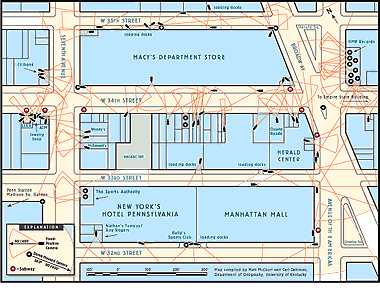 |
| Map compiled by Matt McCourt and Carl Dahlman, Department of Geography, University of Kentucky. (Click on the map above to see a larger version (60k)). |
Private companies will soon launch satellites powerful enough to spot environmental hazards -- or a car in your driveway. Should we worry about snooping from space?
The map above, derived from a recent walking inventory of all easily spotted CCTV cameras in a three-block area of midtown Manhattan, shows a strikingly dense network of cameras, in which coverage of street-level activities is near-total. Although the map can make no claim to represent precisely the viewing capabilities of any one of the more than six dozen cameras shown, it does suggest how much of everyday urban life can fall under the gaze of electronic eyes. The fields of view of interior- and exterior-mounted cameras were assumed to extend ninety and 400 feet, respectively. A camera may zoom, pan, or tilt, or it may sit motionless on its perch, but it will never blink.
The United Kingdom is the unofficial world leader in the use of video technology for public-safety purposes, with substantial government funding for police-monitored cameras. The United States may not be far behind. According to an upcoming -- and admittedly small -- survey by the Security Industry Association, police and municipal organizations in some sixty American cities are using or implementing video technology to monitor public areas in the name of public safety. In New York City the police department is in the process of expanding a program of installing surveillance cameras around housing projects and in parks and subway stations, adding to the countless privately operated cameras already, inevitably, pointing into public spaces. Crime rates may fall; Orwellian fears may rise. What is certain is that "to see and be seen," in cities large and small, is fast taking on a new meaning. -- Allan Reeder
Research for this map, which is the sole responsibility of its authors, was supported by the National Center for Geographic Information and Analysis (under a grant from the National Science Foundation) and John Pickles, Department of Geography, University of Kentucky.
Copyright © 1998 by The Atlantic Monthly Company. All rights reserved.
The Atlantic Monthly; July 1998; To See and Be Seen; Volume 282, No. 1; page 69.
 |
 |
 |
 |
 |
 |